
You walk outside one morning and realize the tree that looked so pretty last week is now all over your lawn. Do you grab the leaf blower, or can this wait until spring?
Here in Michigan, a lot of those leaves can stay right where they are. The Michigan Department of Environment, Great Lakes, and Energy (EGLE) says leaving fallen leaves through fall, winter, and into early spring gives them time to break down and gives wildlife somewhere to spend the winter. So if you were looking for a reason to put the leaf blower back in the garage, there you go.
Underneath those leaves, earthworms, insects, and microbes help break everything down. As the leaves decompose, nutrients return to the soil, where plant roots can use them. In garden beds, a layer of leaves also helps the soil hold onto moisture, buffers it against temperature swings, and makes it harder for weeds to get started. And if you were planning to buy mulch for those beds anyway, some of it just fell out of a tree for free!
There might also be more going on under there than you’d expect. Some butterflies and moths spend the winter tucked among leaves as caterpillars or in cocoons. Fallen leaves can help insulate ground nesting bees, too. And here in Michigan, even cardinals can find a meal in the insects hiding in leaf piles. Leaving a corner of the yard alone gives some of those little creatures a place to make it through winter.
Okay, but what if you can barely see the grass?
That’s when it’s worth doing a little fall cleanup. A thick layer of whole leaves can get wet, mat together, and block sunlight from reaching the grass. If the leaves are scattered and you can still see plenty of grass, you can leave them. If there’s a spot where the grass has practically disappeared, move some of the leaves into a garden bed or around a tree. Keeping them whole preserves more shelter for insects. You can also run a mulching mower over a moderate layer on the lawn and let the little pieces settle between the grass blades. Any extras can go into a compost pile.
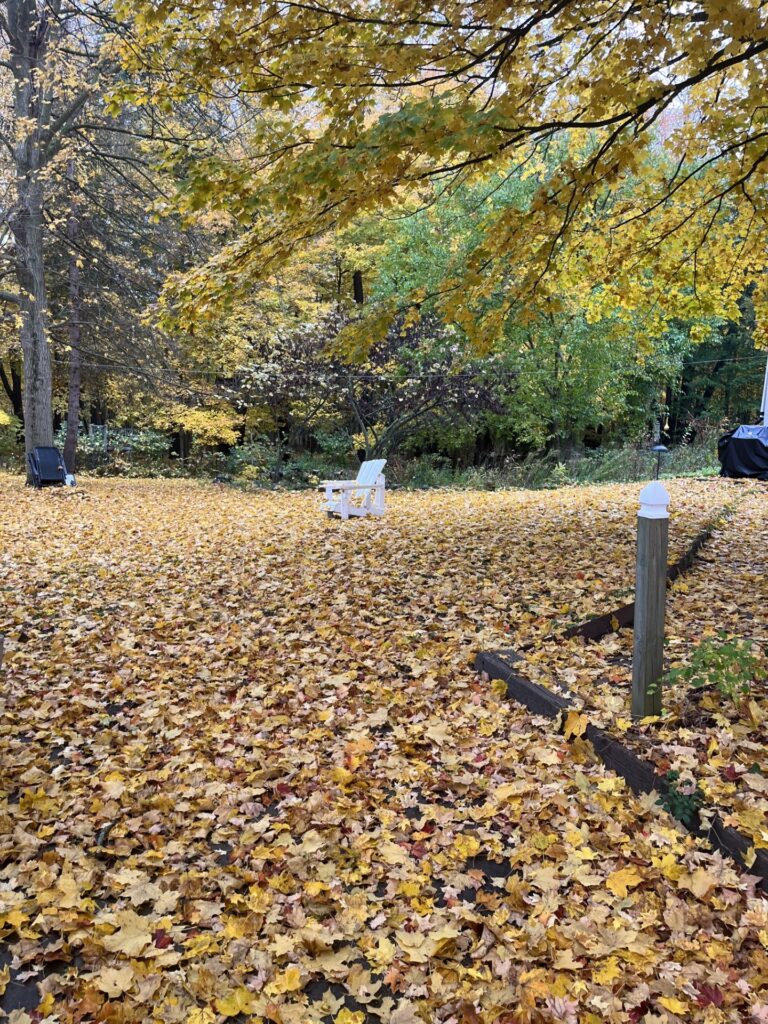
So when should you deal with the wet ones?
If you already know a spot needs clearing, take advantage of a dry day in the fall. Dry or slightly damp leaves are easier to move and shred. Once they’re soaked, they get heavy, stick together, and suddenly the leaf blower has a much harder job. It’s a little like studying or going to the gym. Getting started is usually the part you want to put off, but you’re glad you did it when it’s over.
If it already rained, give the leaves a chance to dry out when you can. And if there’s a soggy mat sitting on the grass and the forecast keeps bringing more rain, go ahead and rake it into a bed instead of waiting for the snow to melt. The leaves already in your beds or tucked away in a corner can stay through winter and into spring, giving the insects shelter until they’re ready to come out.
So before you spend a whole Saturday clearing the yard, take a look at where the leaves actually landed. If the grass is buried, move some leaves. If they’re already in the garden bed, you might be done.
Written by: Romina Viramontes-Vargas K’28, Environmental Stewardship Intern
Larry J. Bell ’80 Environmental Stewardship Center
Subscribe to receive posts about the ESC, academics, student projects and events directly to your inbox!